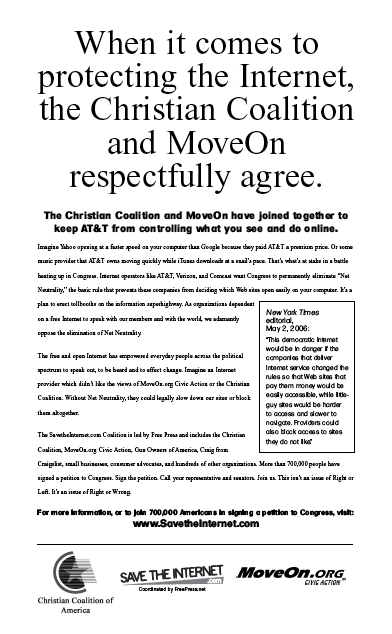
This is the proposed copy for a full page ad in the New York Times. View the pdf here. Join MoveOn and/or the Christian Coalition in calling on Congress to preserve Internet Neutrality. Or don't. But don't complain after the fact.
On that day 139 Americans and an undisclosed number of Iraqis were dead in that conflict. As of May 1, 2006, 2,401 Americans and a still undisclosed number of Iraqis are dead in the fighting.
In time, one wearies of foolishness, but not soon enough. I look at crowded bars on Saturday night as a form of hell. I see the high school girls getting plastered at the prom and vomiting their little hearts out in the parking lot and think, "No more for me, thank you very much." But there is always some fresh foolishness to try.
Here in the Midwest, we're brought up to act older and to be solemn little children, and serious young people. Many of us don't indulge in extravagances (vacations, impractical cars, haircuts that cost more than $10) until our late 30s and early 40s. Having been middle-aged for most of the first half of our life, we start thinking about maybe sowing some of the wild oats we've kept in the granary. Of course, it's hard to be wholly foolish knowing as much Scripture as we do, but sometimes in a particularly warm spring, we achieve a breakthrough and trade in the van on a red MG convertible, have our hair bleached and our foreheads Botoxed, take dancing lessons, buy the powder-blue tuxedo, look at beachfront property on Antigua, and switch from beer to Campari. Our friends are embarrassed for us. We disappear for six months and return, chastened, and take a back pew in church.
The Christian religion, let me point out, is no guarantee against foolishness. In the church that I go to, which is one of those old-fashioned churches where we sing out of hymnals, not off PowerPoint screens, and the minister doesn't have much hair and we don't hold our arms up in the air (we could but it would make it harder to sing from the hymnal), people seem to have about as many problems as they have over at First Atheist. We set out to love our neighbor and the next thing we're running off with her in the red MG.
I have found the adage "Step on a crack and break your mother's back" very useful as a guide in life. It has helped generations of kids imagine that acts have consequences beyond what we can imagine. Without meaning to, you might cause the old lady to suddenly fall to the floor, writhing in pain. Who knows how it happens? It just does. So if you stay off the pavement and walk only on grass or bare dirt, you are likely to stay out of trouble. Try it for 30 days and see if I'm not right.
...I also think it's time that business stood up and joined the immigration debate. I think it has been--with the exception of some high-tech firms--shamefully silent on this, which should be one of its top competitiveness issues. Congress should not be shutting down the borders at a time when we're 10 or 15 years away from some very serious workplace shortages, skilled-labor shortages. We've shut the spigot off, and we're keeping out the very people who would drive our economy 10 years out when our workforce retires en masse.
We talk about these as equity issues, as cost issues, as ideological issues, but more than anything else, they're about competitiveness.
"Taking just the House of Representatives, here is a small slice of who will be leading:
Nancy Pelosi—a progressive—becomes Speaker of the House of Representatives.
John Murtha—a veteran and anti-war champion—would become chair of the House subcommittee on defense appropriations. He would be in charge of the budget for the war in Iraq.
John Conyers—who forced a national debate on the Downing Street Memos—would be chairman of the House Judiciary Committee.
Henry Waxman would be chairman of the Government Reform committee—he has a bulls-eye on war profiteers like Halliburton.
Barney Frank—who has led efforts to rein in out-of-control CEO pay—would be in charge of the Financial Services Committee.
David Obey—who led opposition to the Republican budget—would be chair of the House Appropriations committee—protecting Medicaid, food stamps, veteran's benefits, student loans and more.
Charles Rangel—who predicted the Medicare debacle—would be chair of the House Ways and Means committee—protecting Social Security.
George Miller—a big advocate for working people—would be chair of the House Committee on Education and the Workforce and could bring a vote to raise the minimum wage.
"Put aside for a minute any disappointment you might have in the Democrats overall—these leaders are what we'll get if we win in November. They are champions on issues we all care about."
“I don't think enough people know how much damage this administration can do to their civil liberties in a very short time. What would you have me do? Grumble and complain? Make cynical jokes? Throw up my hands and say that under the circumstances nothing can be done? At least I can muster the facts, establish a record, tell the story that ought to be front-page news.”
Executive Summary
This Minority Report has been produced at the request of Representative John Conyers, Jr., Ranking Member of the House Judiciary Committee. He made this request in the wake of the President's failure to respond to a letter submitted by 122 Members of Congress and more than 500,000 Americans in July of this year asking him whether the assertions set forth in the Downing Street Minutes were accurate. Mr. Conyers asked staff, by year end 2005, to review the available information concerning possible misconduct by the Bush Administration in the run up to the Iraq War and post-invasion statements and actions, and to develop legal conclusions and make legislative and other recommendations to him.
In brief, we have found that there is substantial evidence the President, the Vice President and other high ranking members of the Bush Administration misled Congress and the American people regarding the decision to go to war with Iraq; misstated and manipulated intelligence information regarding the justification for such war; countenanced torture and cruel, inhuman and degrading treatment and other legal violations in Iraq; and permitted inappropriate retaliation against critics of their Administration.
There is a prima facie case that these actions by the President, Vice-President and other members of the Bush Administration violated a number of federal laws, including (1) Committing a Fraud against the United States; (2) Making False Statements to Congress; (3) The War Powers Resolution; (4) Misuse of Government Funds; (5) federal laws and international treaties prohibiting torture and cruel, inhuman, and degrading treatment; (6) federal laws concerning retaliating against witnesses and other individuals; and (7) federal laws and regulations concerning leaking and other misuse of intelligence.
While these charges clearly rise to the level of impeachable misconduct, because the Bush Administration and the republican-controlled Congress have blocked the ability of Members to obtain information directly from the Administration concerning these matters, more investigatory authority is needed before recommendations can be made regarding specific Articles of Impeachment. As a result, we recommend that Congress establish a select committee with subpoena authority to investigate the misconduct of the Bush Administration with regard to the Iraq war detailed in this Report and report to the Committee on the Judiciary on possible impeachable offenses.
In addition, we believe the failure of the President, Vice President and others in the Bush Administration to respond to myriad requests for information concerning these charges, or to otherwise account for explain a number of specific misstatements they have made in the run up to War and other actions warrants, at minimum, the introduction and Congress= approval of Resolutions of Censure against Mr. Bush and Mr. Cheney. Further, we recommend that Ranking Member Conyers and others consider referring the potential violations of federal criminal law detailed in this Report to the Department of Justice for investigation; Congress should pass legislation to limit government secrecy, enhance oversight of the Executive Branch, request notification and justification of presidential pardons of Administration officials, ban abusive treatment of detainees, ban the use of chemical weapons, and ban the practice of paying foreign media outlets to publish news stories prepared by or for the Pentagon; and the House should amend its Rules to permit Ranking Members of Committees to schedule official Committee hearings and call witnesses to investigate Executive Branch misconduct.
The Report rejects the frequent contention by the Bush Administration that their pre-war conduct has been reviewed and they have been exonerated. No entity has ever considered whether the Administration misled Americans about the decision to go to war. The Senate Intelligence Committee has not yet conducted a review of pre-war intelligence distortion and manipulation, while the Silberman-Robb report specifically cautioned that intelligence manipulation "was not part of our inquiry." There has also not been any independent inquiry concerning torture and other legal violations in Iraq; nor has there been an independent review of the pattern of coverups and political retribution by the Bush Administration against its critics, other than the very narrow and still ongoing inquiry of Special Counsel Fitzgerald.
While the scope of this Report is largely limited to Iraq, it also holds lessons for our Nation at a time of entrenched one-party rule and abuse of power in Washington. If the present Administration is willing to misstate the facts in order to achieve its political objectives in Iraq, and Congress is unwilling to confront or challenge their hegemony, many of our cherished democratic principles are in jeopardy. This is true not only with respect to the Iraq War, but also in regard to other areas of foreign policy, privacy and civil liberties, and matters of economic and social justice. Indeed as this Report is being finalized, we have just learned of another potential significant abuse of executive power by the President, ordering the National Security Agency to engage in domestic spying and wiretapping without obtaining court approval in possible violation of the Foreign Intelligence Surveillance Act.
It is tragic that our Nation has invaded another sovereign nation because "the intelligence and facts were being fixed around the policy," as stated in the Downing Street Minutes. It is equally tragic that the Bush Administration and the Republican Congress have been unwilling to examine these facts or take action to prevent this scenario from occurring again. Since they appear unwilling to act, it is incumbent on individual Members of Congress as well as the American public to act to protect our constitutional form of government.
If you're wondering what I'm doing here, at a prayer breakfast, well, so am I. I'm certainly not here as a man of the cloth, unless that cloth is leather. It's certainly not because I'm a rock star. Which leaves one possible explanation: I'm here because I've got a messianic complex.
Yes, it's true. And for anyone who knows me, it's hardly a revelation.
Well, I'm the first to admit that there's something unnatural...something unseemly...about rock stars mounting the pulpit and preaching at presidents, and then disappearing to their villas in the south of France. Talk about a fish out of water. It was weird enough when Jesse Helms showed up at a U2 concert...but this is really weird, isn't it?
You know, one of the things I love about this country is its separation of church and state. Although I have to say: in inviting me here, both church and state have been separated from something else completely: their mind.
Mr. President, are you sure about this?
It's very humbling and I will try to keep my homily brief. But be warned - I'm Irish.
I'd like to talk about the laws of man, here in this city where those laws are written. And I'd like to talk about higher laws. It would be great to assume that the one serves the other; that the laws of man serve these higher laws...but of course, they don't always. And I presume that, in a sense, is why you're here.
I presume the reason for this gathering is that all of us here - Muslims, Jews, Christians - all are searching our souls for how to better serve our family, our community, our nation, our God.
I know I am. Searching, I mean. And that, I suppose, is what led me here, too.
Yes, it's odd, having a rock star here - but maybe it's odder for me than for you. You see, I avoided religious people most of my life. Maybe it had something to do with having a father who was Protestant and a mother who was Catholic in a country where the line between the two was, quite literally, a battle line. Where the line between church and state was...well, a little blurry, and hard to see.
I remember how my mother would bring us to chapel on Sundays... and my father used to wait outside. One of the things that I picked up from my father and my mother was the sense that religion often gets in the way of God.
For me, at least, it got in the way. Seeing what religious people, in the name of God, did to my native land...and in this country, seeing God's second-hand car salesmen on the cable TV channels, offering indulgences for cash...in fact, all over the world, seeing the self-righteousness roll down like a mighty stream from certain corners of the religious establishment...
I must confess, I changed the channel. I wanted my MTV.
Even though I was a believer.
Perhaps because I was a believer.
I was cynical...not about God, but about God's politics. (There you are, Jim.)
Then, in 1997, a couple of eccentric, septuagenarian British Christians went and ruined my shtick - my reproachfulness. They did it by describing the millennium, the year 2000, as a Jubilee year, as an opportunity to cancel the chronic debts of the world's poorest people. They had the audacity to renew the Lord's call - and were joined by Pope John Paul II, who, from an Irish half-Catholic's point of view, may have had a more direct line to the Almighty.
'Jubilee' - why 'Jubilee'?
What was this year of Jubilee, this year of our Lord's favor?
I'd always read the scriptures, even the obscure stuff. There it was in Leviticus (25:35)...
'If your brother becomes poor,' the scriptures say, 'and cannot maintain himself...you shall maintain him.... You shall not lend him your money at interest, not give him your food for profit.'
It is such an important idea, Jubilee, that Jesus begins his ministry with this. Jesus is a young man, he's met with the rabbis, impressed everyone, people are talking. The elders say, he's a clever guy, this Jesus, but he hasn't done much...yet. He hasn't spoken in public before...
When he does, is first words are from Isaiah: 'The Spirit of the Lord is upon me,' he says, 'because He has anointed me to preach good news to the poor.' And Jesus proclaims the year of the Lord's favour, the year of Jubilee (Luke 4:18).
What he was really talking about was an era of grace - and we're still in it.
So fast-forward 2,000 years. That same thought, grace, was made incarnate - in a movement of all kinds of people. It wasn't a bless-me club... it wasn't a holy huddle. These religious guys were willing to get out in the streets, get their boots dirty, wave the placards, follow their convictions with actions...making it really hard for people like me to keep their distance. It was amazing. I almost started to like these church people.
But then my cynicism got another helping hand.
It was what Colin Powell, a five-star general, called the greatest W.M.D. of them all: a tiny little virus called AIDS. And the religious community, in large part, missed it. The ones that didn't miss it could only see it as divine retribution for bad behaviour. Even on children...even [though the] fastest growing group of HIV infections were married, faithful women.
Aha, there they go again! I thought to myself judgmentalism is back!
But in truth, I was wrong again. The church was slow but the church got busy on this the leprosy of our age.
Love was on the move.
Mercy was on the move.
God was on the move.
Moving people of all kinds to work with others they had never met, never would have cared to meet...conservative church groups hanging out with spokesmen for the gay community, all singing off the same hymn sheet on AIDS...soccer moms and quarterbacks...hip-hop stars and country stars. This is what happens when God gets on the move: crazy stuff happens!
Popes were seen wearing sunglasses!
Jesse Helms was seen with a ghetto blaster!
Crazy stuff. Evidence of the spirit.
It was breathtaking. Literally. It stopped the world in its tracks.
When churches started demonstrating on debt, governments listened - and acted. When churches starting organising, petitioning, and even - that most unholy of acts today, God forbid, lobbying...on AIDS and global health, governments listened - and acted.
I'm here today in all humility to say: you changed minds; you changed policy; you changed the world.
Look, whatever thoughts you have about God, who He is or if He exists, most will agree that if there is a God, He has a special place for the poor. In fact, the poor are where God lives.
Check Judaism. Check Islam. Check pretty much anyone.
I mean, God may well be with us in our mansions on the hill. I hope so. He may well be with us as in all manner of controversial stuff. Maybe, maybe not. But the one thing we can all agree, all faiths and ideologies, is that God is with the vulnerable and poor.
God is in the slums, in the cardboard boxes where the poor play house. God is in the silence of a mother who has infected her child with a virus that will end both their lives. God is in the cries heard under the rubble of war. God is in the debris of wasted opportunity and lives, and God is with us if we are with them. "If you remove the yoke from your midst, the pointing of the finger and speaking wickedness, and if you give yourself to the hungry and satisfy the desire of the afflicted, then your light will rise in darkness and your gloom with become like midday and the Lord will continually guide you and satisfy your desire in scorched places."
It's not a coincidence that in the scriptures, poverty is mentioned more than 2,100 times. It's not an accident. That's a lot of air time, 2,100 mentions. (You know, the only time Christ is judgmental is on the subject of the poor.) 'As you have done it unto the least of these my brethren, you have done it unto me' (Matthew 25:40). As I say, good news to the poor.
Here's some good news for the president. After 9/11 we were told America would have no time for the world's poor. America would be taken up with its own problems of safety. And it's true these are dangerous times, but America has not drawn the blinds and double-locked the doors.
In fact, you have doubled aid to Africa. You have tripled funding for global health. Mr. President, your emergency plan for AIDS relief and support for the Global Fund - you and Congress - have put 700,000 people onto life-saving anti-retroviral drugs and provided 8 million bed nets to protect children from malaria.
Outstanding human achievements. Counterintuitive. Historic. Be very, very proud.
But here's the bad news. From charity to justice, the good news is yet to come. There is much more to do. There's a gigantic chasm between the scale of the emergency and the scale of the response.
And finally, it's not about charity after all, is it? It's about justice.
Let me repeat that: It's not about charity, it's about justice.
And that's too bad.
Because you're good at charity. Americans, like the Irish, are good at it. We like to give, and we give a lot, even those who can't afford it.
But justice is a higher standard. Africa makes a fool of our idea of justice; it makes a farce of our idea of equality. It mocks our pieties, it doubts our concern, it questions our commitment.
Sixty-five hundred Africans are still dying every day of a preventable, treatable disease, for lack of drugs we can buy at any drug store. This is not about charity, this is about justice and equality.
Because there's no way we can look at what's happening in Africa and, if we're honest, conclude that deep down, we really accept that Africans are equal to us. Anywhere else in the world, we wouldn't accept it. Look at what happened in South East Asia with the tsunami. 150,000 lives lost to that misnomer of all misnomers, "mother nature." In Africa, 150,000 lives are lost every month. A tsunami every month. And it's a completely avoidable catastrophe.
It's annoying but justice and equality are mates. Aren't they? Justice always wants to hang out with equality. And equality is a real pain.
You know, think of those Jewish sheep-herders going to meet the Pharaoh, mud on their shoes, and the Pharaoh says, "Equal?" A preposterous idea: rich and poor are equal? And they say, "Yeah, 'equal,' that's what it says here in this book. We're all made in the image of God."
And eventually the Pharaoh says, "OK, I can accept that. I can accept the Jews - but not the blacks."
"Not the women. Not the gays. Not the Irish. No way, man."
So on we go with our journey of equality.
On we go in the pursuit of justice.
We hear that call in the ONE Campaign, a growing movement of more than 2 million Americans...Left and Right together... united in the belief that where you live should no longer determine whether you live.
We hear that call even more powerfully today, as we mourn the loss of Coretta Scott King - mother of a movement for equality, one that changed the world but is only just getting started. These issues are as alive as they ever were; they just change shape and cross the seas.
Preventing the poorest of the poor from selling their products while we sing the virtues of the free market...that's a justice issue. Holding children to ransom for the debts of their grandparents...that's a justice issue. Withholding life-saving medicines out of deference to the Office of Patents...that's a justice issue.
And while the law is what we say it is, God is not silent on the subject.
That's why I say there's the law of the land¿. And then there is a higher standard. There's the law of the land, and we can hire experts to write them so they benefit us, so the laws say it's OK to protect our agriculture but it's not OK for African farmers to do the same, to earn a living?
As the laws of man are written, that's what they say.
God will not accept that.
Mine won't, at least. Will yours?
[ pause]
I close this morning on...very...thin...ice.
This is a dangerous idea I've put on the table: my God vs. your God, their God vs. our God...vs. no God. It is very easy, in these times, to see religion as a force for division rather than unity.
And this is a town - Washington - that knows something of division.
But the reason I am here, and the reason I keep coming back to Washington, is because this is a town that is proving it can come together on behalf of what the scriptures call the least of these.
This is not a Republican idea. It is not a Democratic idea. It is not even, with all due respect, an American idea. Nor it is unique to any one faith.
'Do to others as you would have them do to you' (Luke 6:30). Jesus says that.
'Righteousness is this: that one should...give away wealth out of love for him to the near of kin and the orphans and the needy and the wayfarer and the beggars and for the emancipation of the captives.' The Koran says that (2.177).
Thus sayeth the Lord: 'Bring the homeless poor into the house, when you see the naked, cover him, then your light will break out like the dawn and your recovery will speedily spring fourth, then your Lord will be your rear guard.' The Jewish scripture says that. Isaiah 58 again.
That is a powerful incentive: 'The Lord will watch your back.' Sounds like a good deal to me, right now.
A number of years ago, I met a wise man who changed my life. In countless ways, large and small, I was always seeking the Lord's blessing. I was saying, you know, I have a new song, look after it¿. I have a family, please look after them¿. I have this crazy idea...
And this wise man said: stop.
He said, stop asking God to bless what you're doing.
Get involved in what God is doing - because it's already blessed.
Well, God, as I said, is with the poor. That, I believe, is what God is doing.
And that is what he's calling us to do.
I was amazed when I first got to this country and I learned how much some churchgoers tithe. Up to 10% of the family budget. Well, how does that compare with the federal budget, the budget for the entire American family? How much of that goes to the poorest people in the world? Less than 1%.
Mr. President, Congress, people of faith, people of America:
I want to suggest to you today that you see the flow of effective foreign assistance as tithing.... Which, to be truly meaningful, will mean an additional 1% of the federal budget tithed to the poor.
What is 1%?
1% is not merely a number on a balance sheet.
1% is the girl in Africa who gets to go to school, thanks to you. 1% is the AIDS patient who gets her medicine, thanks to you. 1% is the African entrepreneur who can start a small family business thanks to you. 1% is not redecorating presidential palaces or money flowing down a rat hole. This 1% is digging waterholes to provide clean water.
1% is a new partnership with Africa, not paternalism toward Africa, where increased assistance flows toward improved governance and initiatives with proven track records and away from boondoggles and white elephants of every description.
America gives less than 1% now. We're asking for an extra 1% to change the world. to transform millions of lives - but not just that and I say this to the military men now - to transform the way that they see us.
1% is national security, enlightened economic self-interest, and a better, safer world rolled into one. Sounds to me that in this town of deals and compromises, 1% is the best bargain around.
These goals - clean water for all; school for every child; medicine for the afflicted, an end to extreme and senseless poverty - these are not just any goals; they are the Millennium Development goals, which this country supports. And they are more than that. They are the Beatitudes for a globalised world.
Now, I'm very lucky. I don't have to sit on any budget committees. And I certainly don't have to sit where you do, Mr. President. I don't have to make the tough choices.
But I can tell you this:
To give 1% more is right. It's smart. And it's blessed.
There is a continent - Africa - being consumed by flames.
I truly believe that when the history books are written, our age will be remembered for three things: the war on terror, the digital revolution, and what we did - or did not to - to put the fire out in Africa.
History, like God, is watching what we do.
Thank you. Thank you, America, and God bless you all.

